Over the course of this project I learned a lot about different social media networks and content types. While I did well on all of the assignments, in running another campaign I would make more content types that I was unable to produce due to COVID-19. For example, I wanted to create podcasts, but I would have needed technology that I do not have readily available to me at home.
Things I have learned since submitting content:
I have learned to add more images to content. In another one of my classes we have been creating a pre-production notebook for a web page. In creating this I have learned how content will appear differently on a mobile device vs a desk top computer. This has allowed me to become more aware of creating responsive content that will translate well onto multiple screen sizes.
My first goal in using social media analytics is to identify trends in engagement. I want to know what types of content are getting the most engagement, as well as what platforms are reaching the largest audience. I want to track growth of followers and answer the questions of who am I reaching, how many people am I reaching, and am I establishing myself as an authority on my topic.
I will use a few different analytical tools for my content. Since part of my content is a blog, I will be using Google Analytics. Google Analytics provides great information on where traffic is coming from, when users are accessing my content and how much traffic my website is seeing. The other analytics I will use will be the in-app analytics for Facebook, Instagram and Twitter. These will give me specific data for my content on each of those social media channels.
From Google Analytics I will specifically be analyzing what channels referrals are coming from. I will also analyze the days and times that I am getting the most traffic. The last important piece of data I will analyze is bounce rate. This is how long users stay on a particular page before leaving, and provides a big clue on how engaging content is.
From Facebook Analytics I will analyze likes and shares, as these are ways of directly seeing how much engagement I am receiving. I will also analyze impressions to see how many times my content is being viewed. From Twitter Analytics I will be analyzing follower growth to see how large my audience is. I will also analyze retweets to see if my content is reaching beyond my followers. Since Instagram hasn’t fully developed their analytics yet, I will analyze likes and number of followers. This will allow me to see my reach on that platform.
I will apply this data to determine if I have met my goals through a series of steps on each platform.
On WordPress I will look at my Google Analytics data to develop an SEO strategy. I will first see what days and times I am getting the most traffic and make sure to post regularly during those times. I will be able to analyze what key words are getting organic traffic, and I will make sure to emphasize those key words in my SEO strategy. I may make sure those words are in the titles of blog posts, or occur more frequently within my posts. Finally, I will look at bounce rate and see if my material is engaging readers enough to keep them on my page.
Similarly on Facebook, Instagram and Twitter I will look at a combination of follower growth and audience engagement. I will know that my goals have been met here when I see an overall growth in numbers of followers. I will also be looking for increased engagement over time with my content. This will look like an increase in average likes, shares and retweets that my content receives.
When I see an overall growth among all of these metrics, I will know that my objectives of growing an audience and establishing myself as an authority in the field have been met.
As COVID-19 continues to spread and impact our daily lives, we are taking measures to protect our staff, families and loved ones. Unfortunately, this comes at the cost of having to scale back on our content for the time being. Thank you for your patience during this unprecedented time. We will be back to our normal content schedule in two weeks.
My third content type are personal stories that I created for WordPress. This is the easiest of my content types to create, as it is primarily verbal content. I used Microsoft Word to create the content. I wrote out the story first, proofread it, and then copy and pasted it into WordPress.
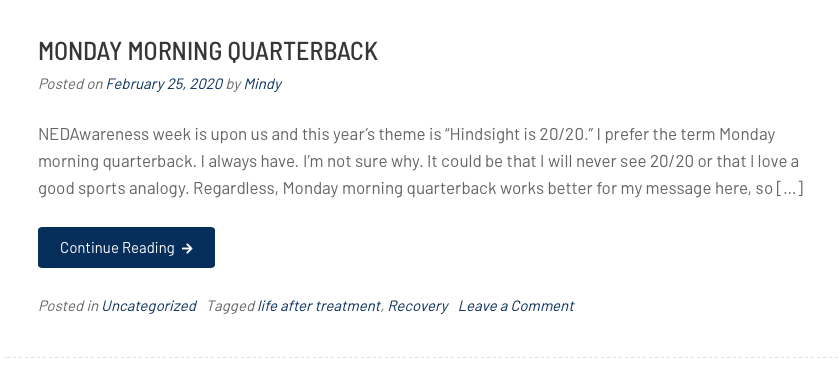
I used metadata by adding tags into my post. These tags are primarily about recovery, as that are what the personal stories gear towards, and the recovery process is an important part of mental health awareness. I also use keywords that I am assisted with by an SEO tool that came with my Blue Host and WordPress package.
My audience engages with my content primarily through sharing my content and comments. My analytics tool tells me that about 30% engage on computers, 10% on tablets, and 60% on mobile devices. Most comments that I get come from sharing on Facebook. Facebook is where most of my referral traffic comes from, with additional traffic from Google and Bing searches, as well as backlinks from other mental health websites.
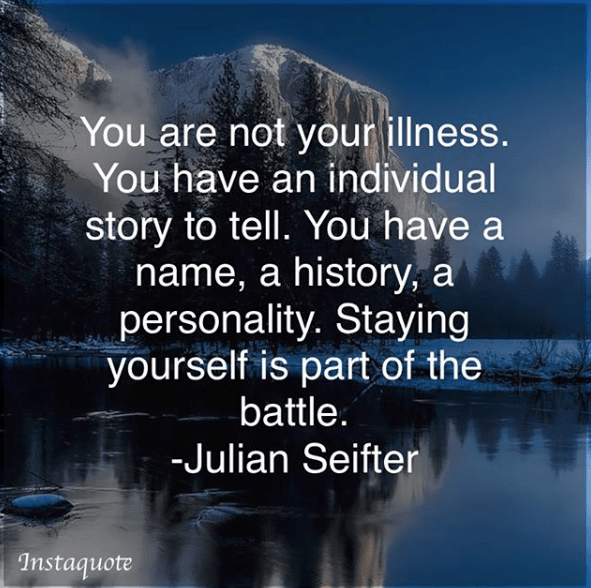
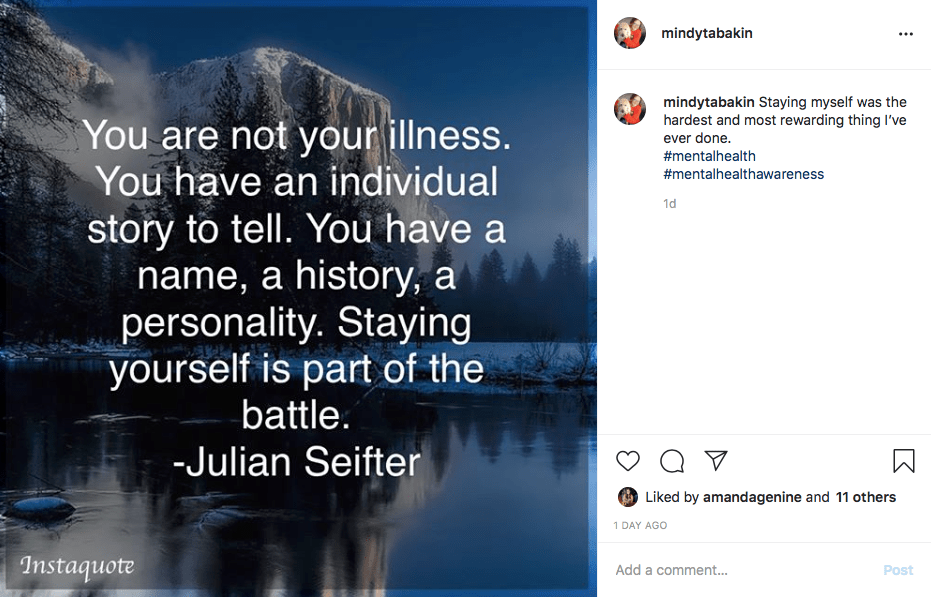
My second content type was quote for Instagram. This was easier to create. I used the app Instaquote to create this, and I was able to just pick a background and add in the quote.
For metadata I again used hashtags related to mental health awareness. The screenshot from Instagram is above, and I will post the link below. My audience engages with Instagram on their mobile devices, and they interact with this content with likes and sharing.
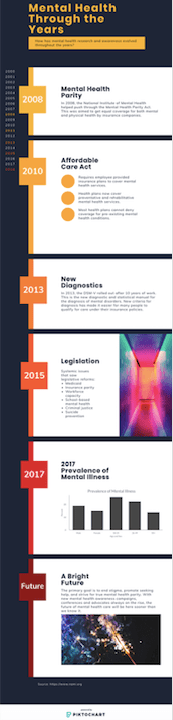
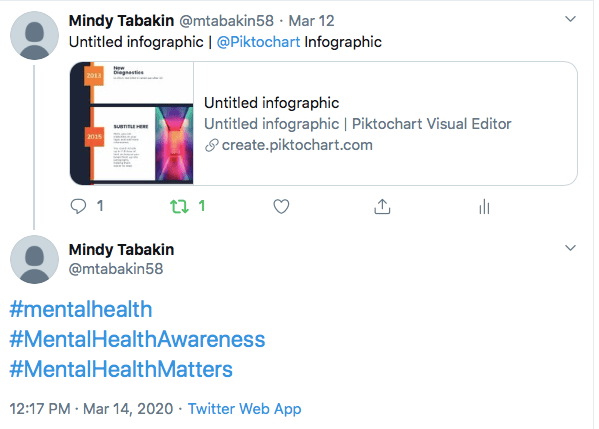
My first content type is an infographic on mental health developments through the years. I created the infographic using the Piktograph program. This was a difficult process as it’s a very new skill for me. I posted it to Twitter. The screen capture is above, and I will provide the link below.
For metadata I used hashtags regarding mental health awareness, since that is the goal of my content. My audience engages with this content by retweeting and liking the post. They will primarily engage on mobile devices.
Running a WordPress site can get complicated. There are so many options as far as paid plans, themes, and optimization. You can have the best content in the world, but it is all for naught if nobody is coming to your page. How can we set ourselves up for the best chance of success? Below I will include a few tips.
Visuals
In order to get people to read your content, you need visuals to grab their attention. These visuals do need to be related to your content in a meaningful way, but it is also important to have that attention grabber to get someone to stop browsing and read what you have to say.
Colors and Themes
Another key to get visitors to your site is to have engaging colors and themes throughout. This can be eye-catching in the same form as visuals, and it can make your site easy to read and fun to browse.
Templates
Having templates for your content will allow users to associate your brand with an image. This will make your site visitors trust you and know what they are in for when they see a link for your posts.
Plugins
Plugins can allow your consumers to have access to your other pages and social networks. They can also allow for increased SEO optimization, blockage of spam, and any other number of things. The more that you pay for a site, the more options you will have over WordPress, but there are always available options. If you decide to download your plugins from another website, make sure that they are reputable and safe.
SEO Optimization
SEO optimization plans with analytics can be purchased with your WordPress site. For your site to get notice make sure that you optimize to a few key words that are specific enough that they will lead users to you. After all, no one scrolls past the first few pages on a Google search.
My topic is proving information and awareness about mental health issues. By providing this information, the ultimate goal would be to reduce stigma around receiving help for mental illness. I would have three main audience groups. The first group would be young individuals, ages 18-25, who are first coming to grips with mental health struggles. These would be primarily female college students. They would primarily come from middle to upper class families and be Caucasian. Their political leanings are more liberal, and they are trying to find information about their struggles and where to go for help.
My second audience group would be mental health professionals. These professionals would include therapists, psychiatrists, and primary care physicians. They would have achieved either a masters degree or a doctorate in medicine, and they would be 30-45 years old Caucasians. These are upper class individuals making upwards of $100,000 per year. Their political leanings would also be more liberal, and they would be primarily female clinicians. They would not only interact with my content for information, but they would also be guest bloggers and provide recommendations for resources to be listed through my platform.
My final audience would be parents of adult children struggling with mental illness. They would be interacting with my content to find information to help their children, and to have a platform to reach out to other adults in a similar situation to them. These adults would be primarily male, as this is often the parent who wants to “fix” the child. They would be primarily in the 50-60 year age range. They hold a variety of professions, and most are middle to upper class.
My first persona is Kelly. She is a 19 year old college student at Stanford University. She comes from a large family. She has overprotective parents and four siblings. She struggles with depression and anxiety that became worse when she left home for the first time to go to college. She comes from a wealthy family, and she is far away from home for the first time. She is originally from St. Louis, Missouri. She is a very good student majoring in engineering. She also is a competitive athlete, and she plays volleyball for Stanford. She is outgoing, but she feels the need to hide her depression and anxiety from classmates. She interacts with my content to get more information on her illness and to find providers in her area.
My second persona is Mary. She is a social worker from Calabasas, California. She is 42 years old and has a masters of social work from Berkeley University. She is married and has two children and a dog. Her income is $100,000 per year. She has a passion for helping others and has overcome addiction in her own life. She now helps young adults through the same struggle she overcame years ago. Outside of her private practice, she enjoys going to the beach, going to concerts, and spending time with her family at home. She interacts with my content by providing guest blogs and interviews for podcasts. She also comes to my content to find information on reducing mental health stigma.
My third persona is Steve from Ann Arbor, Michigan. He is 55 years old and has a 19 year old daughter with bipolar disorder who is away at school. He also is married and has another 12 year old daughter. Steve is a Chief Financial Officer for a local nursing home company, and he makes $300,000 a year. He is frustrated that he can’t help his daughter. He interacts with my content to get information to try and help his daughter and research resources that can help him cope with his daughter’s illness. Outside of work he likes to spend time with his family, read, and take his boat out onto the lake.
In an average day, the consumer’s of my content are very busy. They go to work or school and check my content on mobile devices throughout the day in between classes or meetings. In the evening, they may check my content at home on their laptop or desktop computers.
They interact with my blogs on WordPress. Professionals may help with guest blogging, while other consumers will read my content for information to help reduce the stigma they feel or to understand their illness. They interact with podcasts by listening and sharing them with friends, families, and other professionals. They interact with Instagram pictures and Facebook posts by reading, sharing and liking content that includes information as well as support from fellow consumers. They will also look at infographics provided for statistics and facts to make them feel less alone. They will interact with YouTube videos by watching and sharing the videos that will include interviews and information on mental illness and reducing stigma.
Where they consume media and on what device will depend on the type of content. When interacting with Facebook and Instagram, consumers will typically be at work or school. They will be scrolling through my content on their mobile devices during breaks. They may also use mobile devices to scroll through WordPress blogs and infographics on mobile devices on longer breaks throughout the day. They will listen to my podcasts while getting ready in the morning or on their daily commute by hooking their phone up to their car radios. When they come home at the end of the day they will look through WordPress content on a larger computer screen, which will make it easier for consumers to interact with my content. They will also watch YouTube videos at home in the evening, on either their mobile devices or on their computers.
The first term that I find important to know is content curation, which is the process of collecting relevant and important information from the web and presenting it in a meaningful way. I find this important because consumers want to collect the most information possible at one time with minimal effort. By curating as much information as possible into one area, you are satisfying the consumer’s need for lots of information, in an easily digestible way as quickly as possible.
The next term that is important to me is conversions, or an action taken by a website visitor that demonstrates that they are converting into a customer. This is important to know because it will provide a metric for whether the information that I am providing is effective and easily digestible enough for consumers to come back.
The third term that is important to me is SEO, or search engine optimization. This is the process of increasing visibility in search engines, such as Google. While I already knew this term, I am lacking in skill set in this arena. It is important for me to learn more about this because potential consumers will rarely search past the first page in search engines, so it is important to show up on that first page.
The next term, which was completely new to me was Klout score, which rates a social media user based on the size of their networks and how many people interact with them. This is important because if you have worked incredibly hard to curate and present information but no one is interacting with it, then all that effort is for naught. Just like in other areas of life, it is important to have klout in order to grow a business or have your content taken seriously.
The final two terms that I have can work in concert with each other. The first is audience selector, which allows you to choose which users you want to share content with. This is important because it allows for a message to get to a specific audience that will be most likely to interact with your content. Once someone interacts with your content it is important to have a good average response time, or the average amount of time it takes to respond to a consumer. This is important because a quick average response time will instill more trust in consumers and keep them coming back.
The networks that I would like to create content for in this class are Instagram, Facebook, Twitter, WordPress and YouTube. Instagram, Facebook and Twitter work in concert with each other because they allow for you to use the same handle to get information out to different networks of people. Instagram would allow for pictures to show off the majority of the message, while still allowing for a short caption to send the message verbally as well. Twitter and Facebook would allow for the same message to get across in short snippets. Using all three of these networks in concert with each other would allow consumers to see the information on multiple networks, increasing the chance for higher conversion rates. The three networks together would also allow for the message to get across to potential consumers who only use one or two of these networks.
WordPress and YouTube tie in nicely to this, because using the above networks would allow me to post links to WordPress and YouTube content. WordPress would allow me to promote written content, information and streaming content in one website. I am very interested in creating content for YouTube because my video skill set is not developed, and I think potential consumers respond well to videos that allow them to have a sense of a more personal relationship with you.
There were so many types of content that I would like to learn to create. The first is podcasts. I have had an interest in learning how to create podcasts for a long time, and I think that it is a growing area that more and more people are taking interest in. This content would also allow me to easily create interview content by having guests on the podcast to add more information and klout to my content. I would also like to create video content on a network such as YouTube. Consumers like videos because they put both a face to a name and allow information to get out without having to put the effort into reading large amounts of information. I have no experience working with video, but it is a skill set that I would like to add to my arsenal.
I would also like to create lists as content. I know that this is a paper for class, but I also know that if a potential consumer were to look at the information in this paper it would be more easily digestible in list form. Potential consumers today have limited time, and it is easier for them to skim a simple list then to sort through information themselves. Along the same lines, I would like to create infographics. This allows for large amounts of information, statistics, and facts to be placed in one piece of content. They are easy to read and digest, and they don’t take a lot of time or effort to sift through that information. I appreciate the link that you gave me in feedback for assistance in creating these.
The final type of content that I would like to create is personal stories. Potential consumers want to know that someone is human, and being able to connect on that human level could lead to an increased chance of converting to a customer.
In the ever-changing world of social media it is important to keep up with the legal issues that could cause problems and create plans to avoid these issues. I will avoid copyright infringement by making sure that I have permission to use content directly from the creator. If I need to use pictures and I can’t get permission, I will use Creative Commons to find that content. I will avoid defamation by making sure that my facts are always correct, and by making sure that I am clearly stating if something I say is an opinion. I will avoid using music without permission by using stock music or creating my own music when it is needed. Finally, I know that in can be helpful for your message or company to have endorsements through influencers. I will make sure that I stay up to date with the ever-changing guidelines in this area. I will make sure that I know the current applications for how you identify something as being an endorsement, and I will not falsify any endorsements.


 Mental Health Awareness